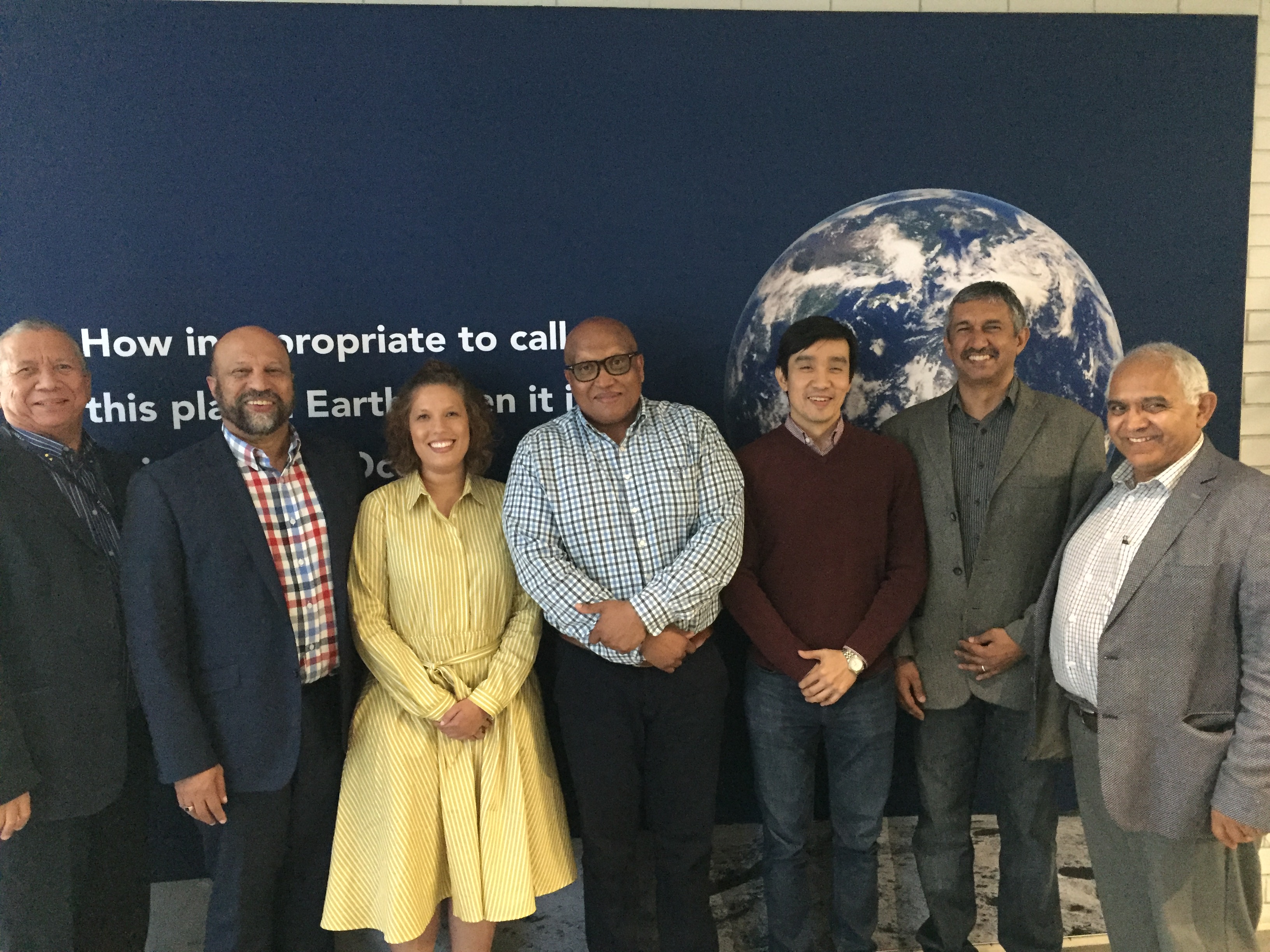
Friday, 24 August 2018 in PORT ELIZABETH, SOUTH AFRICA – CAG conducted a meeting to focus on water, fish farming, food security and job creation in South Africa, where Dr. Randall Jonas (Director of Business School Nelson Mandela University – “NMU”), Mr. Odwa Mtati (Director of The South African International Maritime Institute – “SAIMI”), Mr. Yusuf Adam (“NMU/SAIMI”), Mr. Max Jordaan, Ms. Brigitta, Mr. Roith Rajpal from (MABS Consulting – “MABS”) and Mr. Tan Lin Chung (CAG), and welcomed the establishment of a partnership platform for development of scientific based aqua-industry, which meets the economy needs and security rights of South Africa population.
By 2050 there will be nine billion people on Earth, with populations growing fastest in the low-lying coastal regions. Many of these communities rely on the oceans for food security, but the oceans are warming and food security risks are rapidly rising.
South Africa has one of the largest maritime zones on the continent with a sea area of approximately 2.5 million km2.
In this regard, CAG team believes in real need and potential of this development project in South Africa, and ensures quality application of its solid experience with similar harmonized projects, covering both, scientific and entrepreneurial values.
The first meeting was conducted on in 2017, between Mr. Tan Lin Chung (CAG) and the Chairman of MABS Consulting, Mr. Max Jordaan and Mr. F. Adams of South African Parliament, where all parties agreed to consolidate efforts to highly potential development need in creating new working places and ensuring food security in the region. Since then, both MABS and CAG have been working closely together to achieve the project milestones.
This is a second thematic meeting convoked, where CAG has invited the NMU Ocean Sciences as most strategic scientific base, and SAIMI as a multi-stakeholder institute active in all aspects of the maritime field (including shipping, harbours, manufacturing and construction, sustainability, environment, law, and marine tourism, linking industry and academia in marine and coastal sciences). Both institutions support research needs and professional development in the maritime sector, as well as facilitate international and African continental co-operation in order to meet industry needs.
The initiative started with a common learning and confidence building process. The meeting displayed the need for consolidated approaches and interactions between participants. It is expected that the parties will agree on specific inter-institutional frameworks, form an Advisory Group, comprised of key professionals in the water sector, fish farming and business development, and outline a strategic business plan and implementation roadmap.
The participants emphasized that monitoring and steering as well as decision lines and record keeping between the different organizational units and offices need to be well organized. Together with the local partners from academicians and the entrepreneurs, CAG was highly welcomed to coordinate concrete projects serving for secure sustainable food development of South Africa region.
In the meantime, CAG has conducted a feasibility study to identify the preferred fish species, right technology & system design in bringing New Zealand technology to create a value chain from product to market in the regions (Eastern Cape), right structure for rapid project development and secured land (zone) in Coega Industrial Development Zone (IDZ) region and The Environment Impact Assessment (EIA) has been also done by Coega Development Corporation (CDC).
CAG is exploring the potential of co-operative arrangement with Nelson Mandela University and South African International Maritime Institute in support of aquaculture projects in South Africa, specifically those located within the IDZ of Eastern Cape. The projects shall operate at both trans-sectoral and transboundary levels and responds to demands by economy and private sectors.